A lot of nutrition advice treats a sweet craving like a problem to be defeated — something to resist, distract yourself from, or push through with sheer willpower. That framing doesn’t just feel unpleasant, it also tends not to work very well long-term. A more useful approach starts from a different premise: the craving isn’t the enemy. It’s information. The question is what you do with it.
What a Craving Actually Is
A sweet craving isn’t a character flaw or a sign of weak discipline — it’s a fairly predictable piece of neurochemistry combined with learned habit. Eating something sweet triggers dopamine release, the brain’s core reward signal, which is precisely why sweet food feels genuinely good, not just pleasant in a vague sense. On top of that biological layer, cravings are frequently tied to stress, tiredness, or emotional comfort-seeking, which explains why they tend to spike during exactly the weeks life feels hardest.
Understanding this reframes the whole problem. “Just don’t eat sugar” fails so often not because people lack discipline, but because it’s fighting a real physiological signal with pure denial — a strategy that rarely holds for long against genuine reward-seeking wiring.
Why Willpower-Only Approaches Tend to Backfire
There’s a well-documented pattern in behaviour research: rigid restriction around a craved food often leads to a bigger indulgence later, not less overall consumption. White-knuckling through a sweet craving for hours or days frequently ends in eating considerably more than if the craving had been addressed proportionately in the first place.
This doesn’t mean cravings should be indulged without any thought — it means the smarter strategy isn’t restriction, it’s substitution: finding a way to genuinely satisfy the craving that doesn’t set up the next one an hour later.
The Physiology of “Setting Up the Next Craving”
Here’s where the specific food matters. When you eat something high in refined sugar, blood glucose spikes quickly, triggering an insulin response to bring it back down. With concentrated sugar sources — lollies and soft drinks especially — that process frequently overshoots, dropping blood sugar below where it started. That dip is experienced as the classic “crash”: fatigue, irritability, trouble concentrating, and very often, another sweet craving shortly after.
This is the real mechanical problem with relying on traditional sugary snacks to satisfy a sweet tooth. The short-term satisfaction is completely real — but the crash that follows tends to trigger the next craving almost immediately, creating a cycle that feels a lot like failed willpower but is actually closer to straightforward blood chemistry.
Interrupting the Cycle Without Restriction
A few practical strategies work with the craving rather than against it:
-
Pair sweetness with fibre, protein, or fat. Any of these slows sugar absorption into the bloodstream, blunting the spike-and-crash pattern even when sugar is present. A piece of fruit (which carries fibre) affects blood sugar far more gently than fruit juice (which doesn’t).
-
Choose fibre-sweetened options over sugar-sweetened ones. Snacks sweetened with prebiotic fibres like isomalto-oligosaccharide provide genuine sweetness without triggering the same blood sugar spike as sucrose or glucose syrup, since fibre digests far more slowly.
-
Treat the craving as legitimate, not something to override. Having a genuinely satisfying, well-formulated sweet option available makes it far easier to address a craving proportionately, rather than restricting until an eventual, larger indulgence.
-
Check in on the non-food triggers. Since cravings often spike with tiredness or stress rather than pure hunger, addressing the root cause directly — water, a short walk, an earlier bedtime — sometimes reduces the pull of the craving before you even reach for a snack.
-
Let portioning do quiet work. Sweet cravings are often more about the experience of eating something sweet than about sheer quantity. A well-portioned, genuinely satisfying option is frequently enough on its own, without needing to finish an entire bag to feel resolved.
Watch Out for “Healthy” Alternatives That Don’t Actually Solve This
A lot of products marketed as smarter sweet-tooth options still trigger a meaningful blood sugar spike. Dried fruit is a common example — nutritionally different from candy, but calorie-dense and capable of spiking blood sugar quickly once the water content has been removed and the natural sugars are concentrated. Some “protein” snack bars carry as much added sugar as a standard chocolate bar, just marketed under a different banner.
The reliable signal isn’t the health halo on the front of the packet — it’s the actual sugar content and sweetening method listed in the ingredients and nutrition panel.
A Genuinely Different Approach: Fibre-Sweetened Gummies
One of the more effective recent developments in the better-for-you snack space is gummies and lollies sweetened primarily with prebiotic fibre rather than sugar or sugar alcohols. This targets the spike-and-crash cycle at its root: with minimal actual sugar present to spike blood glucose in the first place, there’s no equivalent crash to trigger the next craving.
This matters particularly for sweet-tooth cravings because gummy-format candy tends to be eaten steadily over a stretch of time — unlike a single square of chocolate, a handful of gummies compounds quickly if the sugar content is high. A fibre-sweetened alternative removes most of that compounding effect, letting a genuine craving be addressed fully without setting up round two.
How Valli Snacks Fits This Approach
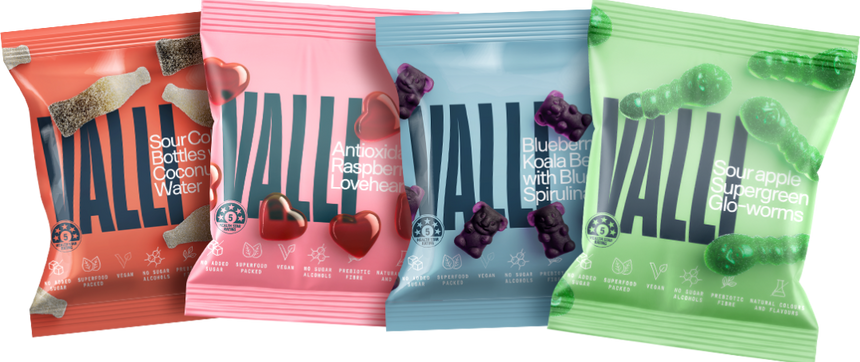
Every flavour across the Valli Snacks range — Sour Apple Supergreen Glo-Worms, Blueberry Koala Bears with Blue Spirulina, Antioxidant Raspberry Lovehearts, and Sour Cola Bottles with Coconut Water — is made with no added sugar and sweetened with isomalto-oligosaccharide instead. Reaching for a handful to address a genuine sweet craving doesn’t come with the blood sugar rollercoaster of traditional candy, while still delivering the chewy, fruity satisfaction that makes lollies effective at addressing a craving in the first place.
Building a Sustainable Relationship With Sweet Cravings
-
Keep a genuinely satisfying, better-formulated sweet option on hand, rather than relying purely on restriction and hoping willpower holds
-
Notice patterns — if cravings consistently hit at a specific time of day, address the underlying trigger alongside the snack itself
-
Treat an occasional traditional treat as neutral, not a failure — the goal is a better overall pattern, not flawless restriction
-
Prioritise sleep and stress management, since both directly influence how intense cravings feel in the first place
The Bottom Line
A sweet tooth isn’t a problem to defeat through discipline — it’s a signal worth listening to and addressing intelligently. Choosing options that provide genuine sweetness without triggering the classic spike-and-crash cycle lets a craving be fully satisfied, rather than quietly setting up an even stronger one later in the day.
Ready to satisfy a sweet craving without the crash that usually follows? Explore the Valli Snacks range — genuinely sweet, made with no added sugar, and formulated to keep you feeling steady.