
Few pairs of food labels cause as much quiet confusion as “no added sugar” and “sugar-free.” Shoppers routinely assume they’re interchangeable, use them to make opposite purchasing decisions, or trust whichever one sounds more virtuous on a given day. None of that is really anyone’s fault — the terms are legitimately confusing, and the food industry hasn’t done much to clarify them. Here are five direct questions that cut through most of the confusion in one pass.
Question 1: Do these labels mean the same thing?
No — and this is the single biggest misconception worth correcting first. “No added sugar” means no sugar was added during manufacturing, but the product can still contain naturally occurring sugars from fruit, dairy, or other whole-food ingredients. “Sugar-free” means the total sugar content falls below a strict regulatory threshold (typically under 0.5g per 100g), regardless of source.
In practice, this means a “no added sugar” product can sometimes contain more total sugar than a “sugar-free” one — the label tells you about manufacturing choices, not final sugar content.
Question 2: What sugar level actually qualifies as “sugar-free” in Australia?
Under the Australia New Zealand Food Standards Code, a “sugar free” claim requires the product to contain no more than 5g of sugars per 100g of solid food (or 2.5g per 100mL for liquid food). That’s worth knowing specifically because it’s a more generous threshold than the 0.5g per 100g figure used in the EU and UK — a product labelled “sugar-free” in Australia isn’t held to the same bar as one carrying that label overseas.
To hit that threshold while still tasting sweet, sugar-free products almost always rely on one of two routes: sugar alcohols (maltitol, sorbitol, xylitol, and similar) or non-nutritive sweeteners (stevia, sucralose, and others). Both provide sweetness with minimal impact on blood sugar, which is the entire point of a sugar-free formulation.
The catch worth knowing: sugar alcohols aren’t fully absorbed by the digestive system. In moderate amounts most people tolerate them fine, but in larger quantities they can cause bloating or a laxative effect — which is why sugar-free products often carry a small-print warning about “excessive consumption.”
Question 3: Is one of these definitely healthier than the other?
Not automatically, and this is where a lot of shoppers get tripped up chasing the “safer-sounding” label. A “no added sugar” fruit product might carry a meaningful natural sugar load. A “sugar-free” product might rely heavily on sugar alcohols in a way that doesn’t suit everyone’s digestion. Neither claim, on its own, guarantees the product is well-formulated.
The only reliable way to judge is to flip the packet over and check the actual nutrition panel — specifically total sugar per serving and the type of sweetener used — rather than trusting the front-of-pack claim to do that work for you.
Question 4: Is there a third option that avoids both trade-offs?
Yes, and it’s becoming more common in the better-for-you snack space specifically: sweetening with a prebiotic fibre instead of either sugar or sugar alcohols. Isomalto-oligosaccharide (IMO) is the most widely used example — a plant-derived fibre with a naturally mild sweetness, digested very differently to both sugar and sugar alcohols.
This approach sidesteps the usual trade-off entirely. There’s no added sugar to spike blood glucose, and because it isn’t a sugar alcohol, it doesn’t carry the same digestive-discomfort risk in larger amounts. As a bonus, it actively contributes to daily fibre intake rather than being a neutral substitution.
Question 5: How do I actually check which one a product is using?
Skip the front-of-pack claim and go straight to the ingredients list. Look for:
Sugar alcohols — listed by name (maltitol, sorbitol, erythritol, xylitol) or under a “polyols” heading
Non-nutritive sweeteners — stevia, steviol glycosides, sucralose, monk fruit extract
Fibre-based sweeteners — isomalto-oligosaccharide, inulin, chicory root fibre
Then cross-check against the nutrition panel’s total sugar and dietary fibre figures. A product with low sugar and meaningfully high fibre is very likely using the third approach — and it’s generally the gentlest option on digestion while still avoiding added sugar.
A Worked Example
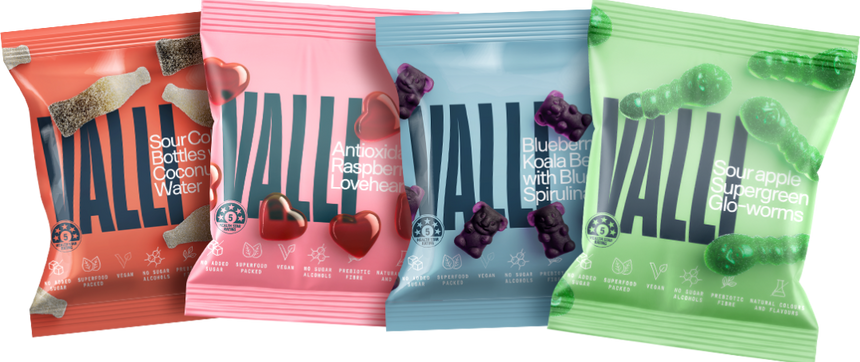
Here’s how this plays out with an actual product. Valli Snacks gummies are formulated with no added sugar, and specifically avoid sugar alcohols in favour of isomalto-oligosaccharide as the primary sweetener. That single choice means:
No added sugar (so it qualifies for that claim honestly)
Not reliant on sugar alcohols (so no unusual digestive risk in normal serving sizes)
A meaningful dietary fibre contribution per serving, since IMO functions as a prebiotic fibre once it reaches the gut
This is the practical upside of understanding the difference between these labels: once you know what to look for, you can identify formulations like this one, which sidestep the usual “pick your trade-off” problem entirely.
Common Mistakes Worth Avoiding
Assuming “natural” implies low sugar. Natural sugar is still sugar, metabolically. A “naturally sweetened” product can carry a substantial sugar load.
Assuming sugar-free is automatically gut-friendly. Some sugar-free products lean heavily on sugar alcohols, which can have the opposite effect in larger servings.
Trusting the biggest word on the pack. Marketing claims are regulated but still selectively chosen — a brand will always lead with its most flattering claim, not necessarily its most complete one.
Ignoring serving size. A product can look reasonable “per serve” but less so once you account for how much people typically eat in one sitting — particularly true for lolly-format snacks eaten steadily through a movie or a drive.
The Bottom Line
“No added sugar” and “sugar-free” are genuinely different, legally defined claims — not interchangeable marketing synonyms — and neither one is automatically the better choice without checking what’s actually inside. The most reliable shortcut is learning to recognise the three sweetening approaches (sugar, sugar alcohols, or fibre-based sweeteners like IMO) and choosing based on what you actually want: avoiding sugar, avoiding digestive discomfort, or ideally, both at once.
Want to see the fibre-sweetened approach in action? Explore the Valli Snacks range — no added sugar, no sugar alcohols, just a genuinely different way to sweeten a gummy.