
Walk into any supermarket and you’ll see both phrases plastered across packaging: “no added sugar” and “sugar-free.” They sound like they mean the same thing, and most shoppers assume they’re interchangeable.
They’re not — and understanding the difference can meaningfully change which snacks you choose, especially if you’re managing sugar intake for health, weight, or dental reasons.
Here’s a clear breakdown of what each term actually means, and how to shop smarter using them.
What “No Added Sugar” Actually Means
“No added sugar” means exactly what it says: no sugar has been added during processing or preparation.
However — and this is the part that trips people up — the product can still contain naturally occurring sugars from ingredients like fruit, fruit juice concentrate, or dairy.
For example, a “no added sugar” fruit snack might still contain a meaningful amount of natural fructose from the fruit itself.
That’s not necessarily a bad thing — natural sugars from whole fruit typically come packaged with fibre, which slows sugar absorption — but it does mean “no added sugar” isn’t the same as “zero sugar” or “won’t affect blood sugar.”
What “Sugar-Free” Actually Means
“Sugar-free” generally means the product contains less than a very small, regulated threshold of sugar per 100g or 100ml. Regulations vary slightly by country, but it’s typically under 0.5g per 100g.
To achieve this while still tasting sweet, sugar-free products usually rely on sugar substitutes — most commonly sugar alcohols like maltitol, sorbitol, or xylitol, or non-nutritive sweeteners like stevia or sucralose.
This is where sugar-free products can get complicated.
Sugar alcohols provide sweetness with fewer calories and a much lower impact on blood sugar than regular sugar, but they’re not fully absorbed by the digestive system.
Eaten in large quantities, they can cause bloating, gas, or a laxative effect in some people — which is why many sugar-free product labels carry a small-print warning about “excessive consumption.”
Why This Distinction Matters for Snack Shopping
If you’re specifically trying to avoid sugar alcohols — whether for digestive sensitivity or personal preference — a “sugar-free” label isn’t automatically the safer choice; you need to check exactly what sweetener is being used.
Conversely, if you’re trying to minimise all sugar, including natural sugars, “no added sugar” alone doesn’t guarantee a low-sugar product; you’ll need to check the nutrition panel’s total sugar figure, not just the front-of-pack claim.
The most reliable approach in either case is the same: flip the product over and check the actual grams of sugar per serving on the nutrition information panel, rather than relying on the front-of-pack claim alone.
A product boasting “no added sugar” with 18g of sugar per serving, from concentrated fruit juice for instance, isn’t meaningfully better than a product with sugar directly listed.
A Third, Less Common Option: Fibre-Based Sweeteners
There’s a growing category of snacks that sidesteps both sugar alcohols and natural fruit sugars by using fibre-based sweeteners instead — most commonly isomalto-oligosaccharide, also known as IMO, a plant-derived prebiotic fibre that has a naturally mild sweetness.
This approach avoids added sugar entirely, doesn’t rely on sugar alcohols, reducing the risk of digestive discomfort, and adds a functional fibre benefit on top of the sweetness.
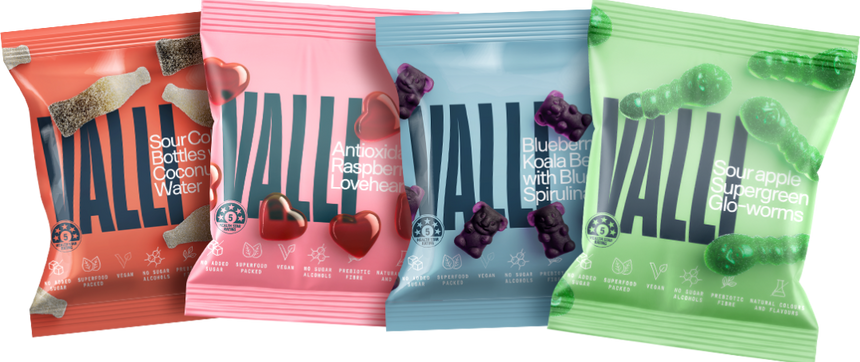
This is the approach used across the entire Valli Snacks range.
Every flavour — from the Antioxidant Raspberry Lovehearts to the Sour Cola Bottles with Coconut Water — is made with no added sugar and sweetened primarily with isomalto-oligosaccharide rather than sugar alcohols, which is part of why the range carries a 5 Health Star Rating.
How to Read a Label Like a Pro
Next time you’re comparing “no added sugar” and “sugar-free” products, run through this quick checklist:
-
Check the ingredients list for the specific sweetener used — sugar alcohol, non-nutritive sweetener, fruit concentrate, or fibre-based sweetener.
-
Check total sugar per serving on the nutrition panel, not just the front-of-pack claim.
-
Check dietary fibre content — a higher fibre count alongside low sugar is generally a strong sign of a well-formulated product.
-
Consider your own tolerance — if you’re sensitive to sugar alcohols, look specifically for fibre-based or stevia-based sweeteners instead.
Common Misconceptions Worth Clearing Up
“Sugar-free automatically means healthier.”
Not necessarily — some sugar-free products rely heavily on sugar alcohols in quantities that can cause digestive discomfort, or use highly processed sweetener blends.
“No added sugar means zero sugar.”
As covered above, this isn’t accurate — natural sugars can still be present and can still be substantial.
“Natural sugar is always fine, added sugar is always bad.”
The body largely processes sugar the same way regardless of source, though naturally occurring sugars in whole foods usually come with fibre that slows absorption — a benefit added sugars don’t provide.
The Bottom Line
“No added sugar” and “sugar-free” are regulated terms with genuinely different meanings, and neither one is automatically the healthier choice without checking what’s actually in the product.
The most reliable way to compare snacks is to look past the front-of-pack claim entirely and check the nutrition panel and ingredients list directly — paying attention to total sugar, the specific sweetener used, and fibre content.
Want a snack that skips both added sugar and sugar alcohols?
Explore the Valli Snacks range, sweetened with prebiotic fibre instead of sugar alcohols or added sugar.