
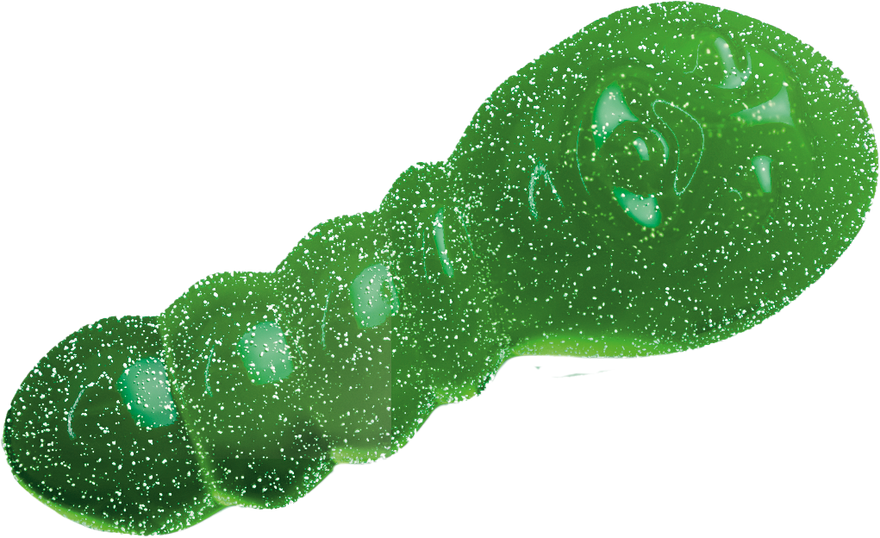
Here’s a fact that surprises a lot of people, including many long-time vegetarians: the overwhelming majority of gummy lollies on supermarket shelves are not vegan, and there’s usually nothing on the front of the packet that would tip you off. The culprit is a single functional ingredient, quietly holding the whole product together — and once you know to look for it, you’ll start noticing it everywhere.
The Ingredient Hiding in Plain Sight
That bouncy, chewy texture that defines a classic gummy bear, worm, or snake almost always comes from gelatin — a protein extracted by boiling animal bones, skin, and connective tissue, typically sourced from cattle or pigs. It’s been the default gelling agent in confectionery for generations, precisely because nothing else replicated that exact chew as reliably or as cheaply.
The reason it stays hidden isn’t deception exactly — it’s just that gelatin is functional, not flavour or branding, so it rarely gets called out anywhere except the ingredients list itself, in small print, using a name most shoppers don’t think to search for.
Why This Catches Even Careful Shoppers Off Guard
Vegetarians and vegans are usually alert to obvious animal products — meat, dairy, eggs. Gelatin slips past that radar because it doesn’t look or taste like an animal product at all. A strawberry-flavoured, plant-shaped gummy bear gives no visual or flavour cue that its structure came from an animal by-product. Unless someone has specifically learned to check for gelatin, it’s an easy thing to miss for years.
The Plant-Based Alternative That Actually Works
The good news is that gelatin has a genuinely effective replacement: pectin, a naturally occurring fibre found in the cell walls of fruit — most commonly apples and citrus. Pectin has become the standard choice for vegan gummies because, unlike some of its alternatives, it delivers a chew and bounce close enough to gelatin that most people can’t tell the difference blind.
Other plant-based options exist too. Agar agar, derived from seaweed, sets firmer and is common in some gummy formats, though it produces a slightly different texture than gelatin. Carrageenan, another seaweed derivative, has become less common recently due to some consumer concerns around digestive tolerance in high amounts.
Beyond Gelatin: The Other Ingredients Worth Checking
Gelatin is the headline issue, but it’s not the only one. A genuinely vegan gummy also needs to be free of:
Beeswax or shellac (confectioner’s glaze) — sometimes used for shine on hard candy or chocolate coatings, both derived from insects
Carmine (cochineal) — a red colourant made from crushed insects, occasionally used instead of synthetic red dye
Honey — sometimes appears in “natural” candy formulations as a sweetener
Milk-derived ingredients — whey or milk solids, occasionally present in coated products
A product can pass the “no gelatin” test and still fail on one of these less obvious inclusions, so a genuine vegan claim needs to clear all of them, not just the headline one.
How to Actually Verify a Product Is Vegan
The most reliable method is a two-step check, since front-of-pack claims alone aren’t always rigorous:
-
Look for a genuine vegan certification, not just a self-declared “suitable for vegans” statement. Third-party certification carries more weight because it’s independently verified.
-
Read the ingredients list yourself, confirming the gelling agent is explicitly pectin, agar, or another named plant-based option — and scanning for the less obvious ingredients above.
If a product doesn’t explicitly state its gelling agent anywhere, the safest working assumption is that it’s gelatin-based, since that remains the industry default.
It’s Not Just Vegans Who Care About This
Interestingly, demand for gelatin-free confectionery extends well beyond people following a vegan diet. Meaningful segments of the market choose pectin-based gummies for reasons that have nothing to do with veganism specifically:
Religious dietary requirements, where gelatin sourced from pork (or non-halal or non-kosher sources generally) is a genuine concern, not a lifestyle preference
General preference for plant-based ingredients without following a strict vegan diet overall
An assumption — often a correct one — that brands willing to reformulate away from gelatin have also put more care into removing artificial colours and sweeteners elsewhere
This last point is worth dwelling on. Reformulating a gummy to use pectin instead of gelatin requires real technical effort — it’s not a cosmetic label change. Brands that make that investment tend to be the same ones paying closer attention to sugar content, colouring, and overall ingredient quality across the board.
A Word of Caution: Vegan Doesn’t Mean Healthy
It’s worth being clear that “vegan” and “healthy” are separate questions entirely. A gummy can be perfectly vegan — pectin-based, no animal derivatives — and still be loaded with sugar and artificial colouring. If you’re choosing candy on both ethical and nutritional grounds, you need to check vegan status and ingredient quality as two separate boxes, not assume one implies the other.
What Getting This Right Looks Like
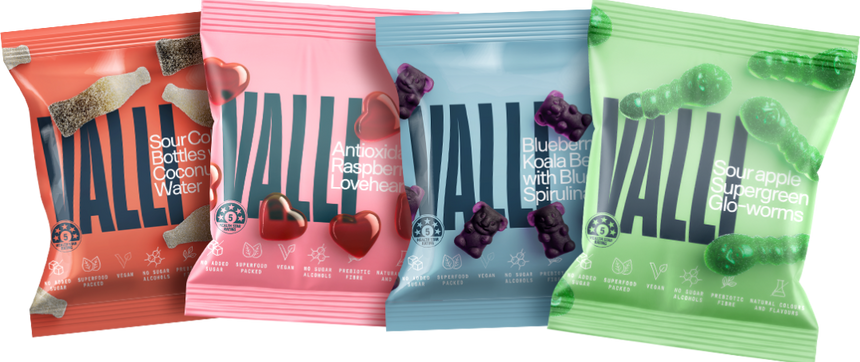
Valli Snacks built its entire range around pectin from the outset — every flavour, from the heart-shaped Antioxidant Raspberry Lovehearts to the Blueberry Koala Bears with Blue Spirulina, uses pectin instead of gelatin, alongside a formulation that skips added sugar entirely and uses natural colours rather than synthetic dye or animal-derived colourants like carmine. The result checks both boxes at once — genuinely vegan, and genuinely better-formulated — rather than treating them as separate marketing decisions.
Quick Reference Checklist
✅ Gelling agent explicitly named as pectin, agar, or another plant-based alternative
✅ No carmine, beeswax, shellac, or honey listed
✅ A real vegan certification or clearly stated formulation, not just an assumption
✅ Checked separately for sugar content and colouring quality, since vegan status doesn’t guarantee either
The Bottom Line
Most traditional gummy candy isn’t vegan, and the reason is a single, easy-to-miss ingredient that rarely gets flagged anywhere except the small print. Once you know to check for gelatin — and the handful of other animal-derived ingredients that can sneak in alongside it — finding a genuinely plant-based gummy becomes a lot easier, and the good ones no longer ask you to compromise on taste or texture to get there.
Curious what a properly reformulated, pectin-based gummy actually tastes like? Shop the Valli Snacks range — no gelatin, ever.