
If you’ve ever assumed all gummy candy was vegan simply because it doesn’t contain dairy or eggs, you’re not alone — and you’re also not correct.
The vast majority of gummy sweets on supermarket shelves contain gelatin, an animal-derived ingredient that makes them entirely unsuitable for vegans, and often surprises even long-time vegetarians.
Here’s a complete guide to what makes candy vegan, why most gummies fail the test, and how to find ones that don’t.
Why Most Gummy Candy Isn’t Vegan
The chewy, bouncy texture that defines gummy candy — gummy bears, worms, snakes, and most fruit-shaped lollies — almost always comes from gelatin.
Gelatin is a protein derived by boiling animal bones, skin, and connective tissue, typically sourced from cattle or pigs. It’s what gives traditional gummies their characteristic stretch and chew.
Because gelatin is functional, not just a flavour or colour additive, it’s difficult to spot on a label unless you know to look for it specifically.
It’s not always obvious from a product’s name or marketing, which means many gummy candies marketed with health-conscious branding — “made with real fruit,” “no artificial colours” — are still entirely non-vegan due to the base ingredient holding them together.
What Makes a Gummy Actually Vegan
For a gummy to be genuinely vegan, gelatin needs to be replaced with a plant-derived setting agent.
The most common alternatives are:
Pectin — a naturally occurring fibre found in the cell walls of fruit, particularly apples and citrus. It’s the most widely used vegan gelling agent in gummy candy and produces a texture close to traditional gummies.
Agar agar — derived from seaweed, agar is another plant-based gelling agent, though it typically produces a firmer, less chewy texture than pectin.
Carrageenan — also seaweed-derived, sometimes used in combination with other gelling agents, though it’s become less common due to some consumer concerns about digestive tolerance in large amounts.
Pectin has become the industry standard for vegan gummies because it most closely replicates the chew and mouthfeel people expect from traditional gelatin-based candy, without requiring an adjustment period for the consumer.
Beyond Gelatin: Other Non-Vegan Ingredients to Watch For
Gelatin is the most common issue, but it’s not the only one.
When checking whether a candy is genuinely vegan, also watch for:
Beeswax or shellac, also known as confectioner’s glaze — sometimes used as a glossy coating on hard candy or chocolate-covered products, both derived from insects.
Carmine, also known as cochineal — a red colouring derived from crushed insects, occasionally used in place of synthetic red dyes.
Honey — used as a sweetener in some “natural” candy formulations.
Milk-derived ingredients — including whey or milk solids, sometimes present in coated or filled candies.
A genuinely vegan gummy should be free of all of the above, not just gelatin.
How to Verify a Product Is Vegan
The most reliable approach is a two-step check:
-
Look for an explicit vegan claim or certification on the packaging — a genuine vegan-certified logo carries more weight than a brand simply stating “suitable for vegans” without third-party verification.
-
Cross-check the ingredients list — confirm the gelling agent listed is pectin, agar, or another plant-based option, and scan for the less obvious non-vegan ingredients above.
If a gummy candy doesn’t explicitly state its gelling agent or vegan status, the safest assumption is that it contains gelatin, since that remains the default across the traditional confectionery industry.
Why Vegan Candy Has Grown Beyond the Vegan Community
Interestingly, demand for vegan-formulated candy has grown well beyond people following a strict vegan diet.
A meaningful portion of vegan gummy buyers are people motivated by:
Religious or cultural dietary requirements, where gelatin sourced from pork or non-halal/non-kosher animals is a concern.
General preference for plant-based ingredients, without following a fully vegan lifestyle.
Perceived cleaner formulation, since brands making the effort to reformulate with pectin often apply the same care to removing artificial colours and sweeteners elsewhere in the product.
This broader appeal is part of why vegan-formulated gummies have moved from a niche health-store category into mainstream snack aisles.
Vegan Doesn’t Automatically Mean Healthy
It’s worth separating two things that often get bundled together.
“Vegan” refers only to the absence of animal-derived ingredients, not the overall nutritional profile of the product.
A vegan gummy can still be loaded with sugar, artificial colours, and minimal nutritional value.
If you’re choosing candy based on both ethical and health considerations, you’ll want to check for vegan status and sugar content and ingredient quality separately, rather than assuming one implies the other.
What This Looks Like Done Well
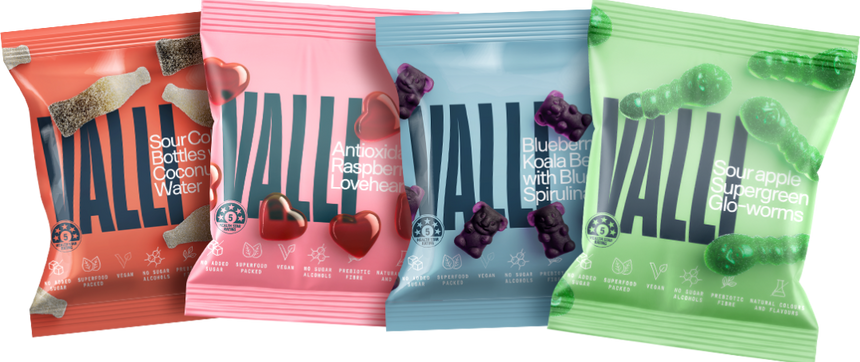
Valli Snacks was built as a fully vegan range from the ground up — every flavour uses pectin instead of gelatin, alongside a broader formulation that skips added sugar entirely in favour of prebiotic fibre, and uses natural colours and flavours rather than artificial dyes or animal-derived colourings like carmine.
The result is a range that satisfies the vegan checklist and the broader “genuinely better-for-you” checklist at the same time, rather than treating them as separate boxes to tick.
Flavours like the Antioxidant Raspberry Lovehearts and Blueberry Koala Bears with Blue Spirulina demonstrate that pectin-based gummies can hold the same shape, chew, and bounce people expect from traditional candy — the plant-based swap doesn’t require a compromise in eating experience.
Quick Checklist for Vegan Candy Shopping
✅ Gelling agent is pectin, agar, or another plant-based alternative — not gelatin
✅ No carmine, beeswax, shellac, or honey listed
✅ Clear vegan labelling or certification on pack
✅ Bonus: check sugar content and colouring separately, since vegan doesn’t guarantee either is well-formulated
The Bottom Line
Most traditional gummy candy isn’t vegan, and it’s an easy thing to miss if you’re not specifically checking for gelatin on the label.
Choosing a genuinely vegan gummy means looking past marketing claims and checking the actual gelling agent and ingredient list — and the good news is that well-formulated plant-based alternatives like pectin now deliver the same texture people love, without the animal-derived ingredient.
Looking for gummies that are vegan by design, not by accident?
Shop the Valli Snacks range — pectin-based, no gelatin, and formulated to taste exactly like the candy you already love.